
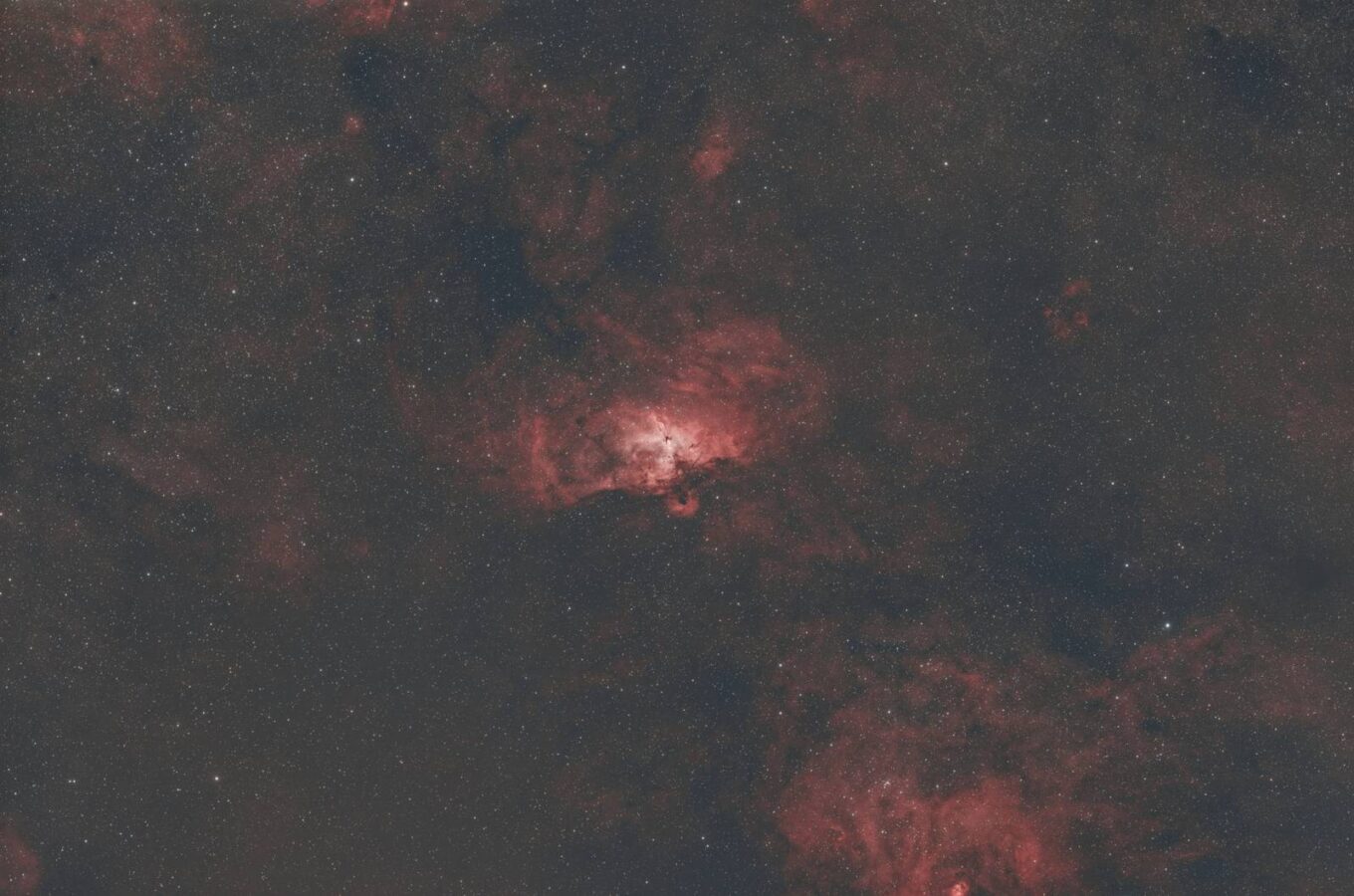
Eagle Nebula
About this image
Messier 16, better known as the Eagle Nebula, is one of the great summer nebulae of the northern sky. Found in the constellation Serpens, it is a huge region of glowing gas, dark dust, and young stars. At its centre lies the open cluster NGC 6611, whose hot young stars illuminate and shape the surrounding nebula.
This image was taken using my William Optics RedCat 51, a small wide-field refractor that is ideal for capturing larger nebulae and surrounding star fields. With its short focal length, the RedCat gives a wider view of M16, showing not only the bright central region but also some of the surrounding nebulosity and context around the object.
The most famous feature inside M16 is the Pillars of Creation, a set of dark columns of gas and dust where new stars are forming. These structures were made famous by the Hubble Space Telescope, but even from the ground with amateur equipment, it is possible to capture the wider nebula and hint at the dark shapes within it.
From the UK, M16 is a challenging target because it sits low in the southern sky. This means imaging through more atmosphere, haze, and light pollution. Good planning, clear skies, and careful processing are needed to bring out the detail.
The rich red tones in the image come from hydrogen-alpha emission, where gas is being energised by young, hot stars. The darker areas are lanes of dust blocking the light behind them, giving the Eagle Nebula its dramatic shape and structure.
What makes M16 so interesting is that it is not just a beautiful object; it is an active stellar nursery. The gas and dust in this region are being sculpted by radiation and stellar winds, while new stars continue to form inside the dense clouds.
For me, this is exactly the kind of target that shows the strength of the RedCat 51. It may be a small telescope, but paired with a dedicated astronomy camera and enough exposure time, it can reveal vast deep-sky structures thousands of light-years away.
M16 is a reminder that astrophotography is not just about magnification. Sometimes the wider view tells the better story.
Annotated image
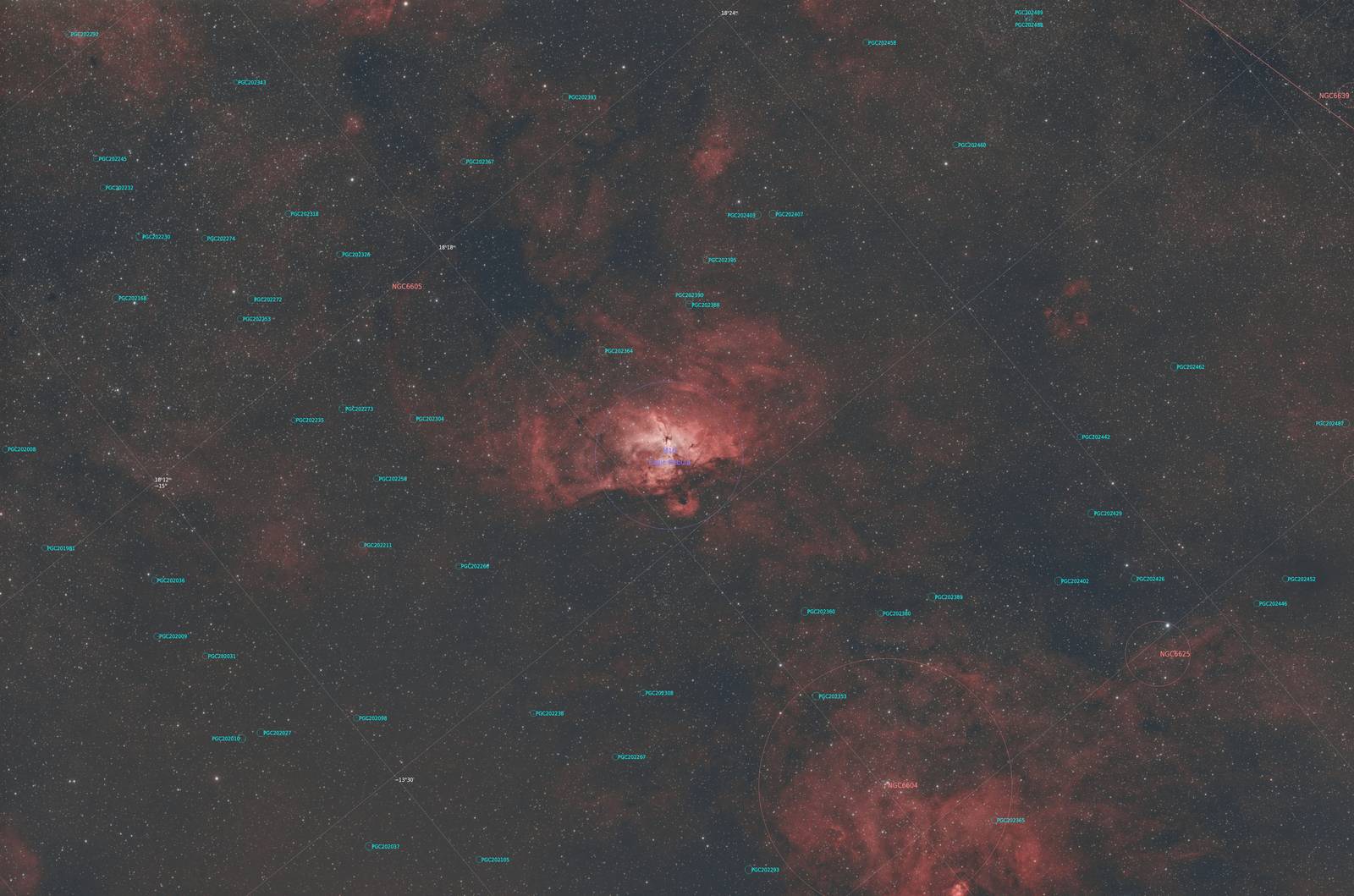
Image details
| Object type | cluster associated with nebulosity |
|---|---|
| Catalogue | M16, NGC 6611, IC 4703, M 16 – NGC 6611 – IC 4703 – SH 2-49 – RCW 165 – LBN 67 – CR 375 – MEL 198 – CED 159 |
| Constellation | Serpens (Ser) |
| Observed | 2025 Apr 29 – 00:00 UTC |
| Location | Portsmouth, UK |
| Moon | Waning Crescent – 18% illuminated – age 25.4 days |
| WordPress categories | Nebula |
Equipment
| Telescope | William Optics RedCat 51 |
|---|---|
| Camera | ZWO ASI2600MC Pro |
| Mount | AZ/GTI |
| Filter | Optolong L-eNhance |
| Focal length | 250mm |
| F-ratio | f/4.9 |
| Pixel scale | 3.1 arcsec/pixel |
Acquisition
| Exposure | 135 x 120s |
|---|---|
| Gain | 100 |
| Guiding RMS | <1.5 |
Observation notes
Captured over two nights 29 & 30th April 2025
Processing notes
Astro Pixel Processor. Processer in Siril
Posted from CityAstroLog.