
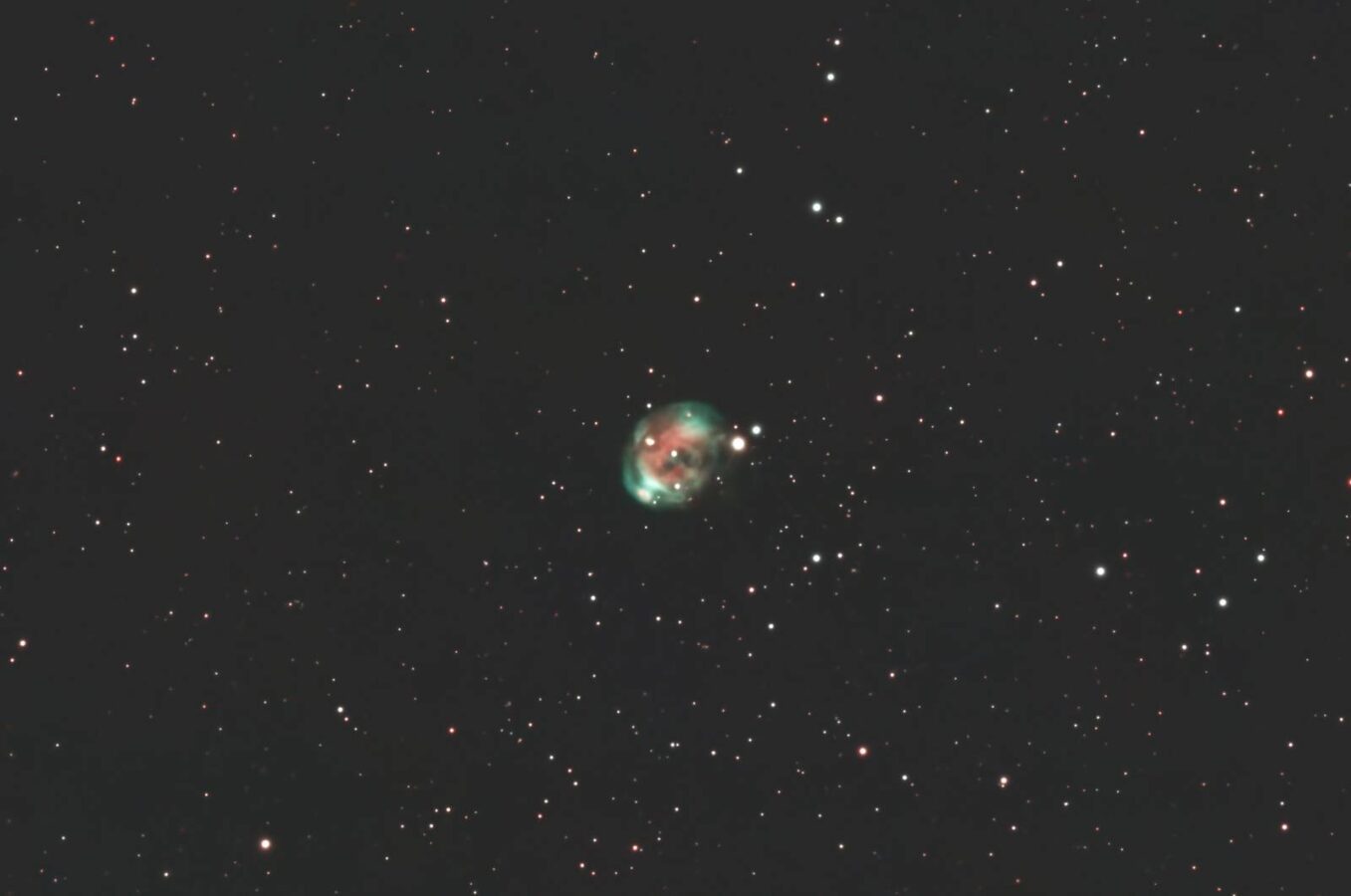
Fetus Nebula
About this image
NGC 7008 – The Fetus Nebula
NGC 7008, commonly known as the Fetus Nebula, is a fascinating planetary nebula located approximately 2,800 light-years away in the rich star fields of the constellation Cygnus. Measuring around 1.4 arcminutes across, it spans roughly one light-year in diameter, making it a compact but rewarding target for high-resolution astrophotography.
Despite its unusual nickname, the nebula has nothing to do with the birth of stars. Instead, it represents the final stages in the life of a Sun-like star. After exhausting its nuclear fuel, the dying star expelled its outer layers into space, leaving behind an intensely hot white dwarf at its centre. Ultraviolet radiation from this stellar remnant causes the surrounding gas to glow, producing the striking colours and intricate structures seen in deep images.
The nebula's irregular appearance is thought to result from multiple episodes of mass loss, interacting stellar winds, and its collision with the surrounding interstellar medium. These processes have created a complex network of knots, arcs and delicate filaments, making NGC 7008 one of the more structurally interesting planetary nebulae in the northern sky. The bright oxygen emission gives much of the nebula its characteristic blue-green colour, while hydrogen emission highlights the surrounding shell.
Although its integrated magnitude is around 10.7, NGC 7008 is relatively small, meaning it benefits greatly from long focal lengths. Imaging at 1500 mm allows the fine internal detail and subtle texture to become visible, revealing features that are difficult to resolve with shorter focal length telescopes. It is therefore an excellent target for telescopes such as the Sky-Watcher 127 Maksutov, where patience and long integration times can produce surprisingly detailed results.
Discovered by Sir William Herschel in 1787, NGC 7008 remains a favourite among astrophotographers seeking an unusual planetary nebula that rewards careful processing with remarkable detail.
Annotated image
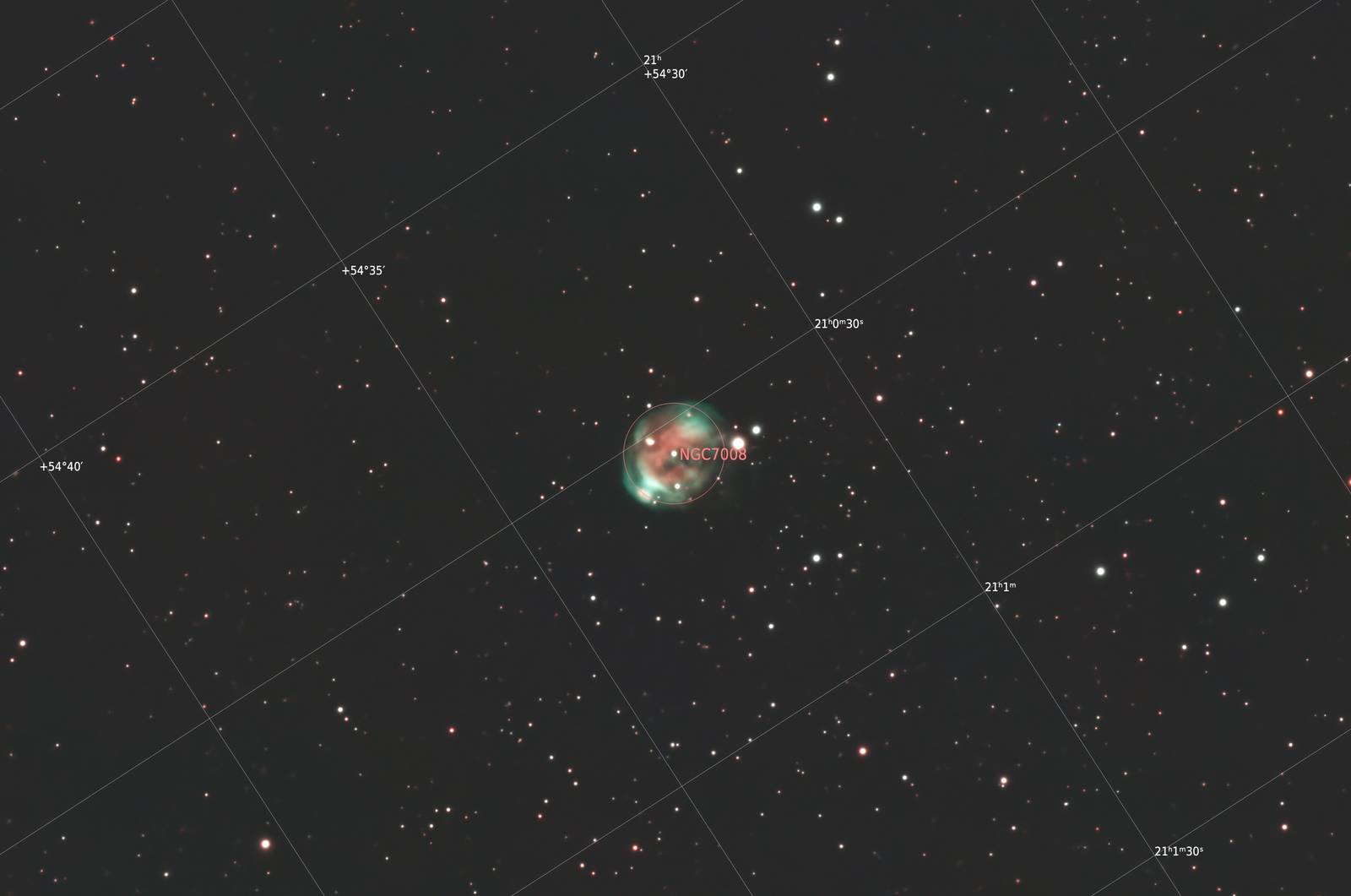
Image details
| Object type | planetary nebula |
|---|---|
| Catalogue | NGC 7008, PK 093+05.2, PN G093.4+05.4, NGC 7008 – CED 186 – PK 093+05.2 – PN G093.4+05.4 |
| Constellation | Cygnus (Cyg) |
| Observed | 2026 Jul 10 – 23:00 UTC |
| Location | Portsmouth, UK |
| Moon | Waning Crescent – 16% illuminated – age 25.7 days |
| WordPress categories | Nebula |
Equipment
| Telescope | Skywatcher 127 Mak |
|---|---|
| Camera | ZWO ASI2600MC Pro |
| Mount | Juwei 17 |
| Filter | L-Enhance |
| Focal length | 1500mm |
| F-ratio | f/11 |
| Pixel scale | 0.52 arcsec/pixel |
Acquisition
| Exposure | 130 x 120s |
|---|---|
| Gain | 100 |
| Guiding RMS | <1.5 |
Observation notes
This image of the Fetus Nebula was captured with my 1500 mm Sky-Watcher 127 Maksutov. Although an f/12 Maksutov isn't the obvious choice for deep-sky imaging, I'm continuing to experiment with its capabilities. The long focal length reveals fine detail in compact nebulae that shorter telescopes can't resolve as easily. While it demands accurate guiding and long integration times, the results have been surprisingly rewarding, proving that with patience and careful processing, even a small Maksutov can produce impressive deep-sky images.
Processing notes
The data was calibrated, registered and stacked in Astro Pixel Processor (APP) before being processed in PixInsight.
Posted from CityAstroLog.