
Great Orion Nebula
About this image
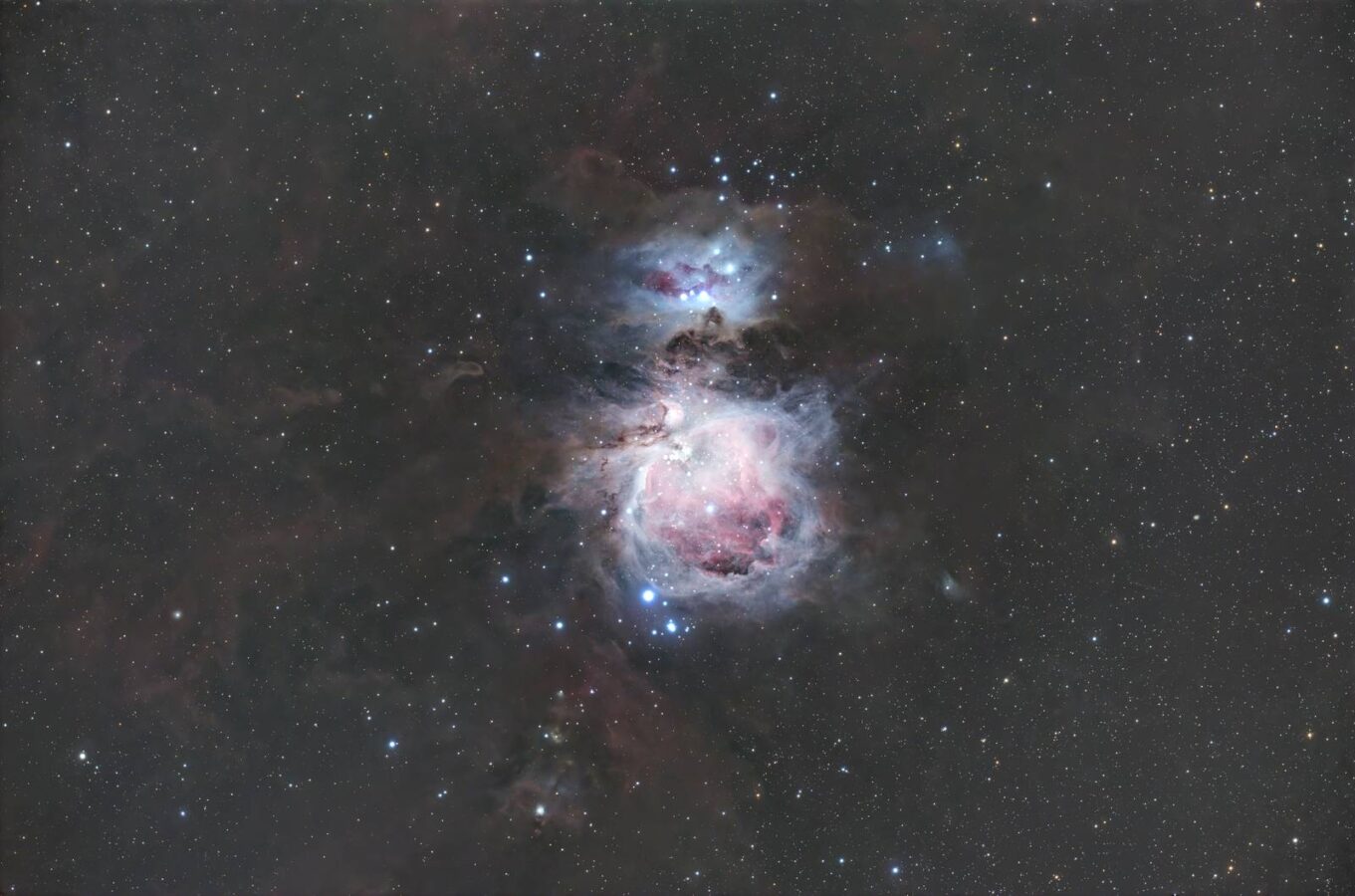
M42, better known as the Orion Nebula, is one of the brightest and most photographed nebulae in the night sky. It sits in the constellation of Orion, just below the three stars of Orion’s Belt, and is around 1,350 light-years from Earth.
The nebula is a huge stellar nursery where new stars are still forming from clouds of hydrogen, gas and dust. At its centre is the Trapezium, a group of young, hot stars whose intense radiation causes the surrounding gas to glow.
M42 is part of the much larger Orion Molecular Cloud Complex, which also includes the Running Man Nebula, the Horsehead Nebula and Barnard’s Loop. Although the bright centre is visible with the naked eye under dark skies, long-exposure photography reveals a much larger and more complex structure than can be seen visually.
Annotated image
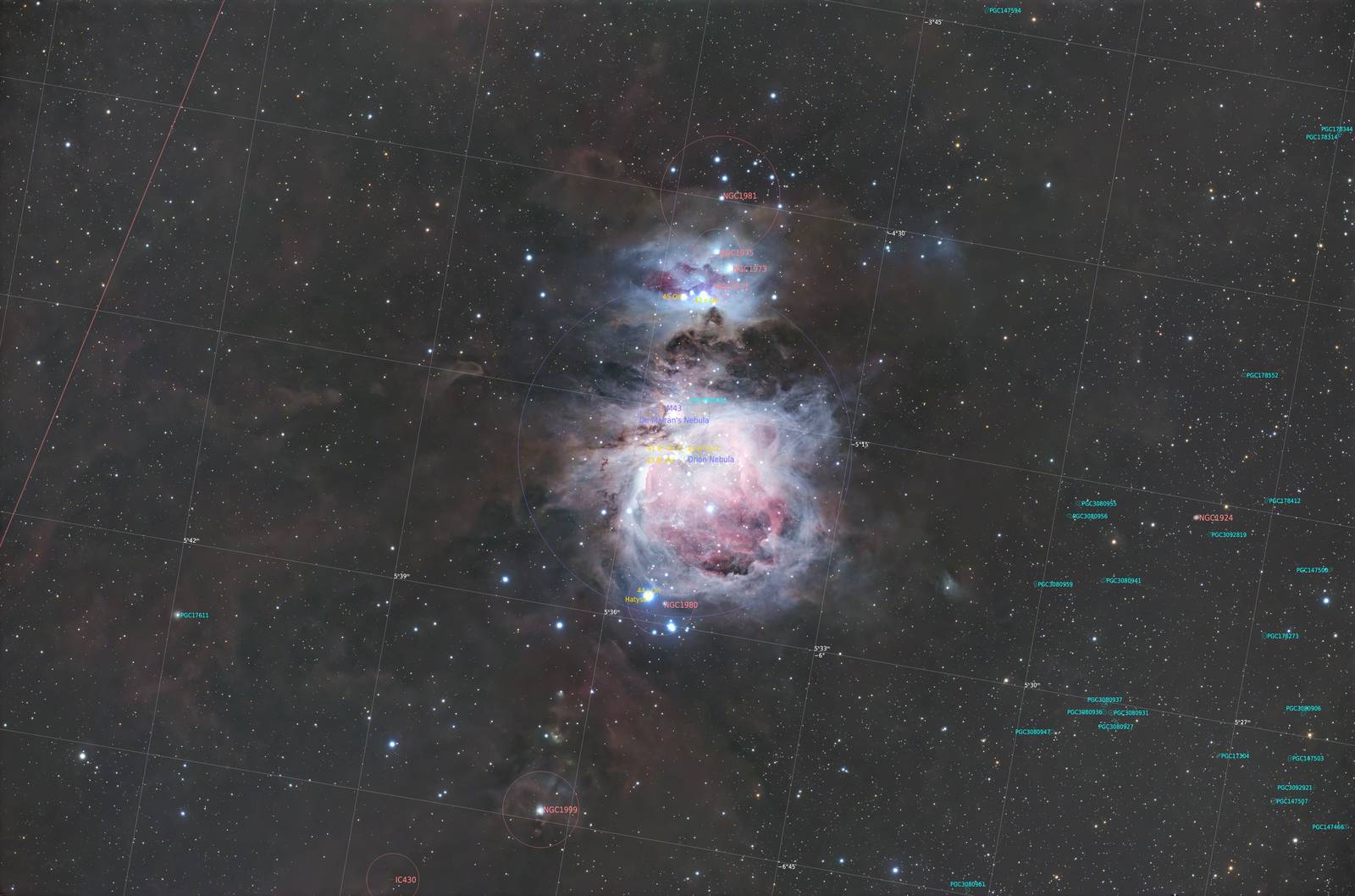
Image details
| Object type | HII region |
|---|---|
| Catalogue | M42, NGC 1976, M 42 – NGC 1976 – SH 2-281 – LBN 974 – CED 55D |
| Constellation | Orion (Ori) |
| Observed | 2025 Dec 25 – 20:44 UTC |
| Location | Portsmouth, UK |
| Moon | First Quarter – 33% illuminated – age 5.8 days |
| WordPress categories | Nebula |
Equipment
| Telescope | William Optics RedCat 51 |
|---|---|
| Camera | ZWO ASI2600MC Pro |
| Mount | AZ/GTI |
| Filter | Optolong L-eNhance |
| Focal length | 250mm |
| F-ratio | f/4.9 |
| Pixel scale | 3.1 arcsec/pixel |
Acquisition
| Exposure | 30 x 120s, 100 X 30s, 100 x 10s |
|---|---|
| Gain | 10 |
| Guiding RMS | >1.5 |
Observation notes
Taken over 3 nights from 24 – 26 December 2025
Processing notes
M42 is one of those targets that never gets boring. It is bright, full of colour and packed with detail, but it is also surprisingly difficult to process properly because of the huge difference between the bright core and the much fainter outer areas.
This image was taken using my RedCat 51. At 250 mm, it gives a wide enough field of view to capture the main Orion Nebula, the Running Man Nebula and some of the surrounding dust and hydrogen clouds.
The biggest challenge with M42 is controlling the bright central core. It is very easy to overexpose the Trapezium while trying to bring out the faint outer structure. I used shorter exposures for the core and longer exposures for the surrounding nebula, before combining the data during processing.
The image was stacked and calibrated in Astro Pixel Processor, with the final processing completed in PixInsight. Careful stretching, colour adjustment and noise reduction were used to bring out the faint detail while keeping the core under control.
The RedCat 51 continues to be one of my favourite telescopes for large nebulae. It is simple to use, produces sharp stars across the frame and gives a great balance between wide-field imaging and fine detail.
Posted from CityAstroLog.