
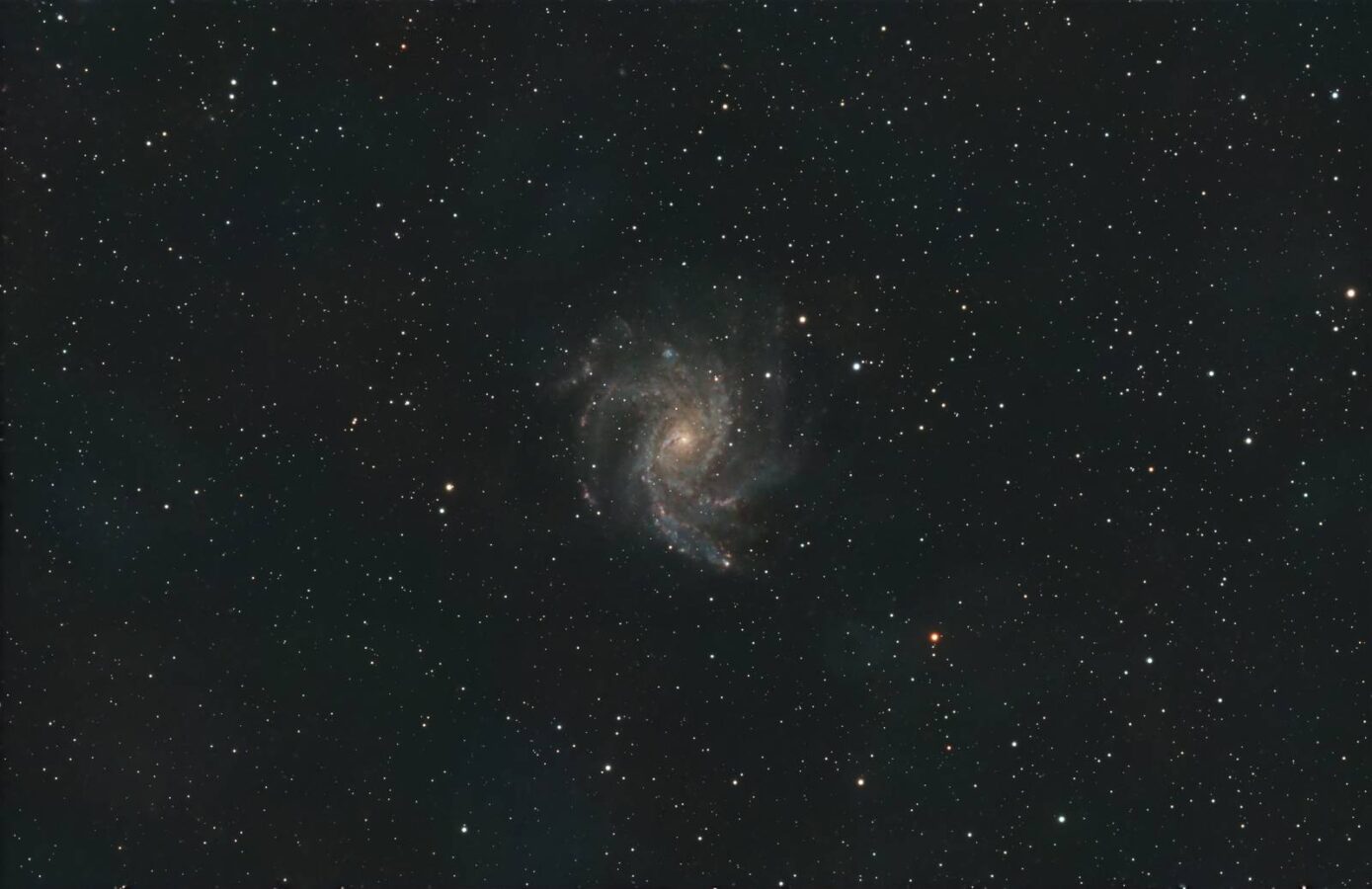
Fireworks Galaxy
About this image
NGC 6946 is one of those galaxies that rewards careful processing. In this image, the bright golden core is surrounded by delicate spiral arms filled with blue young stars, darker dust lanes and small reddish areas of active star formation. The galaxy is viewed almost face-on, allowing much of its structure to be seen clearly, although foreground stars and dust from our own Milky Way add to the challenge.
Known as the Fireworks Galaxy, NGC 6946 lies around 25 million light-years away, close to the boundary between Cepheus and Cygnus. Ten supernovae were observed within it during the last century, an unusually high number compared with the one or two generally expected in the Milky Way over the same period.
What I particularly like about this target is the mixture of subtle detail and colour. The warm central region contains older stars, while the blue and reddish areas scattered throughout the arms reveal regions where new stars are forming. It is not the brightest or easiest galaxy to capture, but with enough data the fragmented arms and dusty structure gradually begin to emerge from the background.
Annotated image
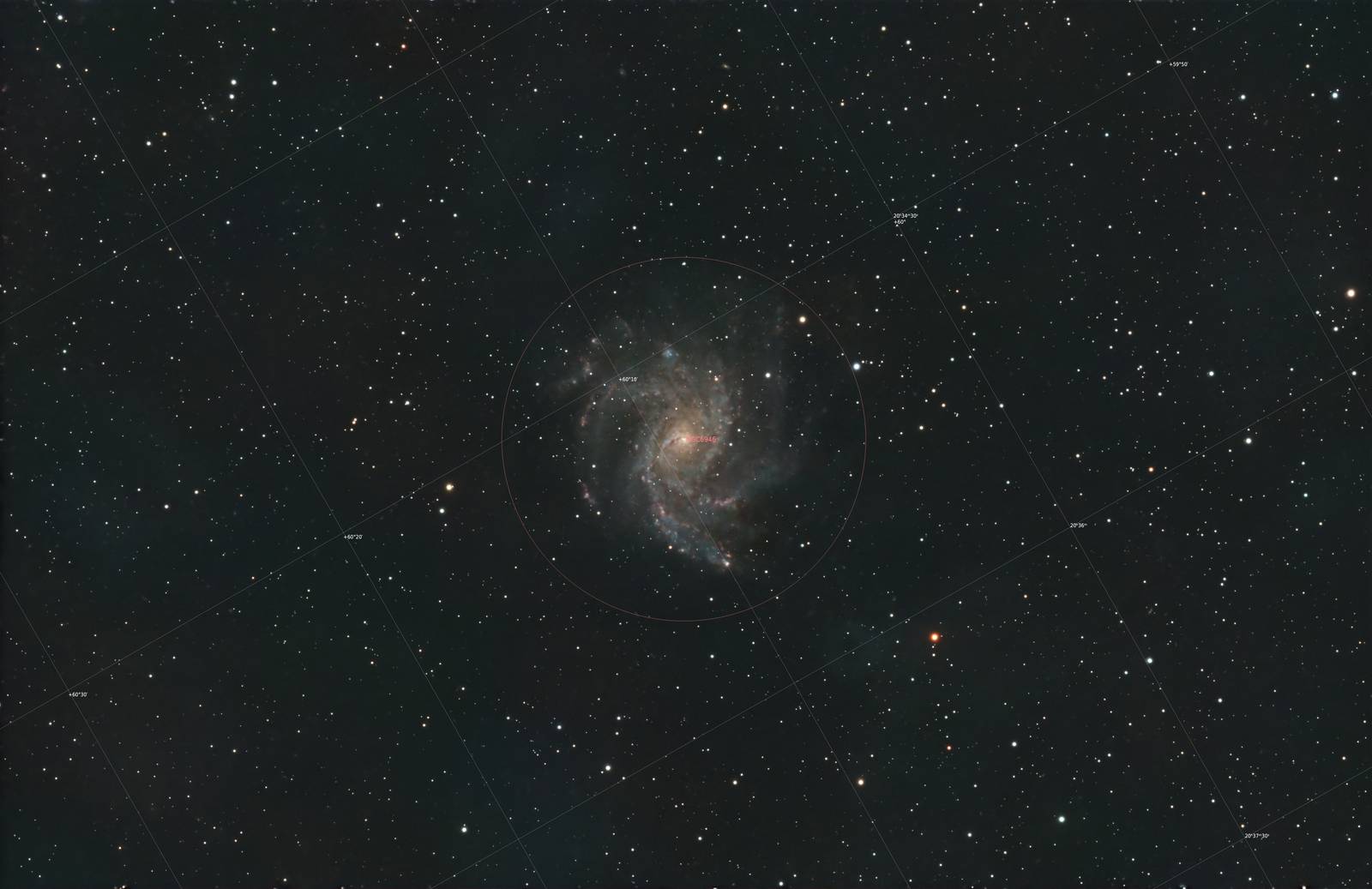
Image details
| Object type | galaxy |
|---|---|
| Catalogue | NGC 6946, PGC 65001, C 12 – NGC 6946 – PGC 65001 – UGC 11597 – ARP 29 |
| Constellation | Cygnus (Cyg) |
| Observed | 2026 Jul 11 – 15:18 UTC |
| Location | Portsmouth, UK |
| Moon | Waning Crescent – 11% illuminated – age 26.4 days |
| WordPress categories | Galaxies |
Equipment
| Telescope | Skywatcher 127 Mak |
|---|---|
| Camera | ZWO ASI2600MC Pro |
| Mount | Juwei 17 |
| Filter | L-PRO |
| Focal length | 1500mm |
| F-ratio | f/11 |
| Pixel scale | 0.52 arcsec/pixel |
Acquisition
| Exposure | 126 X 120x |
|---|---|
| Gain | 100 |
| Guiding RMS | Not recorded |
Observation notes
With only 4 hours of data the Skywatcher 127mm is pretty impressive
Processing notes
The data was calibrated, registered and stacked in Astro Pixel Processor (APP) before being processed in PixInsight.
Posted from CityAstroLog.