
As a long-time visual observer with my 22-year-old Skywatcher 127mm MAK, which is still going strong, I’ve recently upgraded my setup. I’ve added a Skywatcher AZ-GTI mount and a ZWO ASI 678MC USB 3 camera. While planetary imaging presents a whole new set of challenges, my setup is working well, and the tracking is solid. However, focusing on planets, especially when they’re low in the sky, has proven to be the most difficult task. I’m still working my way around, and when they are positioned favourably I aim to capture them.
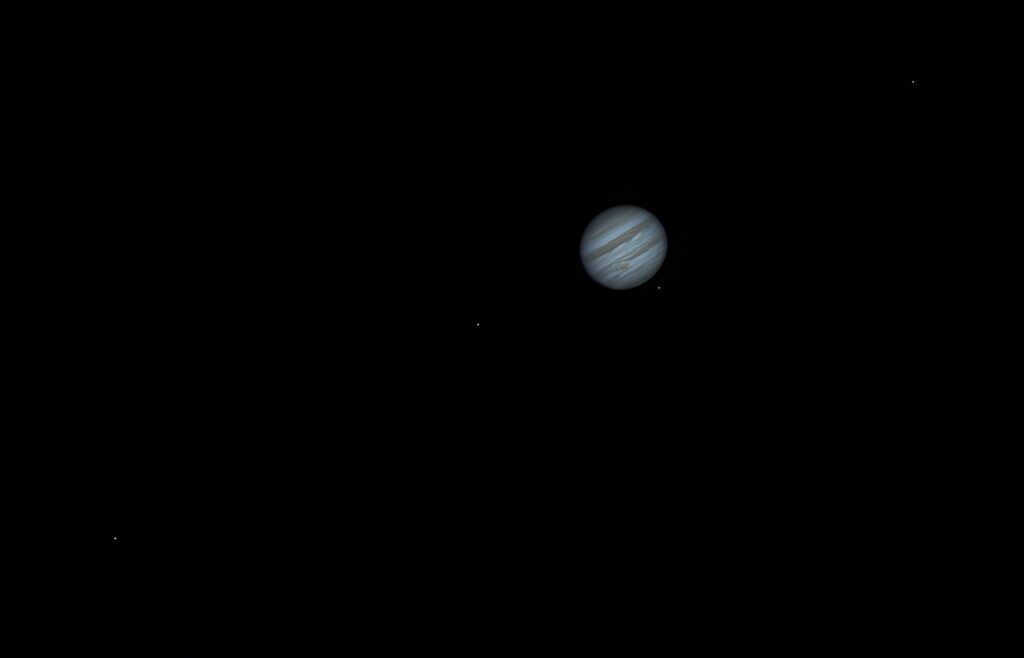
Below is the best image of Jupiter I have so far on a cold December 2024 evening
Jupiter
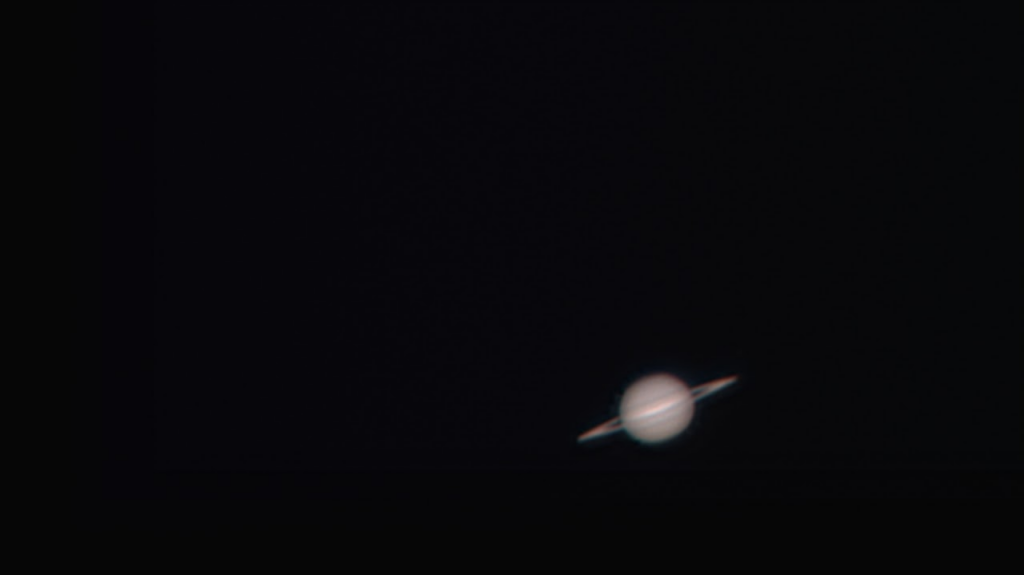
Saturn
Saturn proved to be a difficult target, mainly because the rings were closed.
Uranus
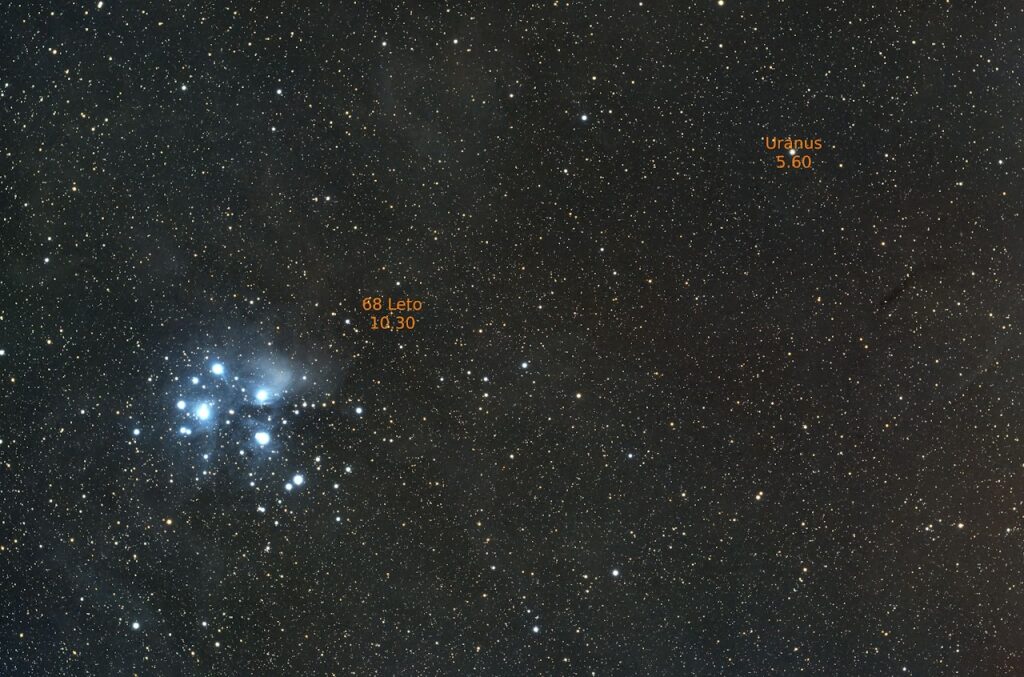
I didn’t use my MAK 127MM for this capture but went for a wide-angle shot as Uranus passed M45 joined by a small asteroid (Leto). During a brief 30-minute gap in the clouds, I managed to capture a single frame containing M45 (the Pleiades), Uranus, and the main-belt asteroid 68 Leto a rare alignment and a satisfying result given the conditions.
Uranus has an interesting history: it was discovered in 1781 by William Herschel, marking the first time a planet had been identified using a telescope rather than the naked eye.
The asteroid 68 Leto also has a story behind it. Discovered on April 29, 1861, by German astronomer Robert Luther, it takes its name from Leto, the mother of Apollo and Artemis in Greek mythology.
Catching all three of these objects together in one shot feels like a small astronomical victory—especially squeezed between fast-moving weather.
General Rule for Planetary Imaging
For planetary imaging, you want to achieve an optimal sampling rate (resolution) to capture the maximum detail, which is often referred to as the “sampling rule”. The general rule is:
Optimal Sampling Rate for Planetary Imaging:
- Formula:
Focal Ratio=5×Pixel Size (in microns)\text{Focal Ratio} = 5 \times \text{Pixel Size (in microns)}Focal Ratio=5×Pixel Size (in microns) - For My Camera ASI678MC:
Optimal Focal Ratio=5×2.0μm=f/10\text{Optimal Focal Ratio} = 5 \times 2.0 \mu m = f/10Optimal Focal Ratio=5×2.0μm=f/10 - My Current Setup:
- My Skywatcher 127mm has a focal length of 1500mm and a focal ratio of f/11.81. This is already very close to the ideal f/10 for my camera, meaning you’re almost at the optimal focal ratio.
Using a Barlow Lens
A Barlow lens increases the effective focal length of my telescope, which increases magnification. But you want to be careful not to “oversample,” which can lead to softer images.
When to use a Barlow:
- With a 2x Barlow lens:
- My effective focal length becomes 3000mm, which gives you a focal ratio of f/23.62.
- This is oversampling for myASI678MC, and while it might work for very bright planets like Jupiter and Saturn, the image may become too soft due to oversampling.
Recommendation:
- My current setup without a Barlow lens for most planetary imaging as I’m already close to the optimal sampling with f/11.81.
- I could use a 1.5x Barlow lens giving you a focal ratio closer to f/17.7, which is still within a reasonable range for my camera.
Conclusion:
- Current setup (no Barlow): Ideal for planets, close to optimal focal ratio.
- 1.5x Barlow: Can be used to slightly increase magnification without oversampling too much.
- 2x Barlow: Might result in oversampling and loss of detail for smaller planets.
Software
Capture sofware: ASIStudio, FireCapture or Sharpcap
Stacking: AutoStakkert!
Regstax6, Lightroom or AstroSurface for4 processing