
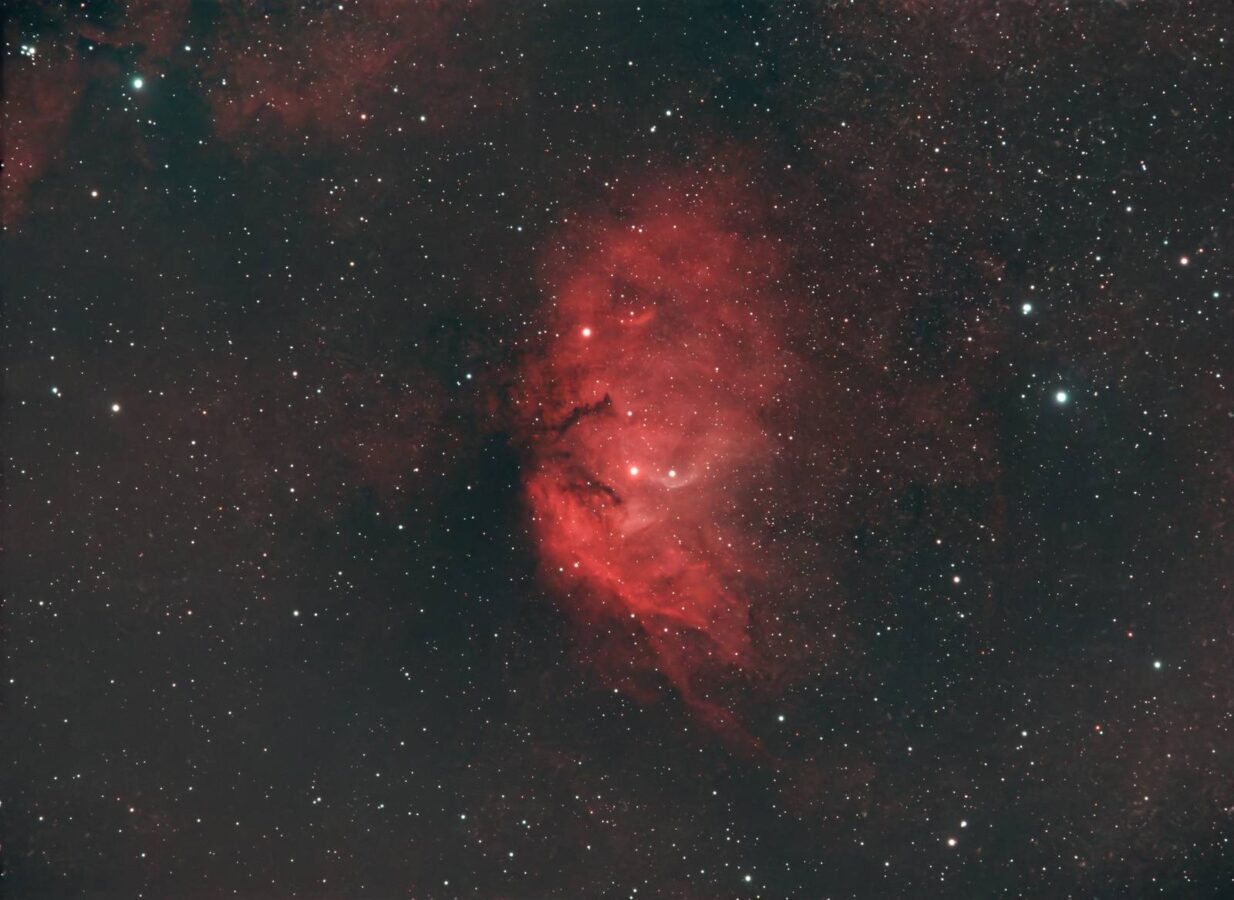
Cygnus Star Cloud
About this image
SH2-101, better known as the Tulip Nebula, is a large emission nebula around 8,000 light-years away in the constellation Cygnus. Spanning roughly 70 light-years, its glowing clouds of hydrogen are energised by radiation from nearby young, massive stars.
I captured this image using the Optolong L-eNhance filter, which helped bring out the strong hydrogen and oxygen emissions while reducing the effects of light pollution.
What makes this area particularly interesting is that it also contains Cygnus X-1, one of the best-known black-hole systems and one of the brightest X-ray sources in our sky. The black hole is pulling material from a massive companion star, producing powerful jets. These jets interact with the surrounding gas and create a faint curved shock front close to the Tulip Nebula—although it is very difficult to capture. I may give it more time, It’s amazing to think that this colourful and peaceful-looking region is sitting alongside such an extreme object.
Annotated image
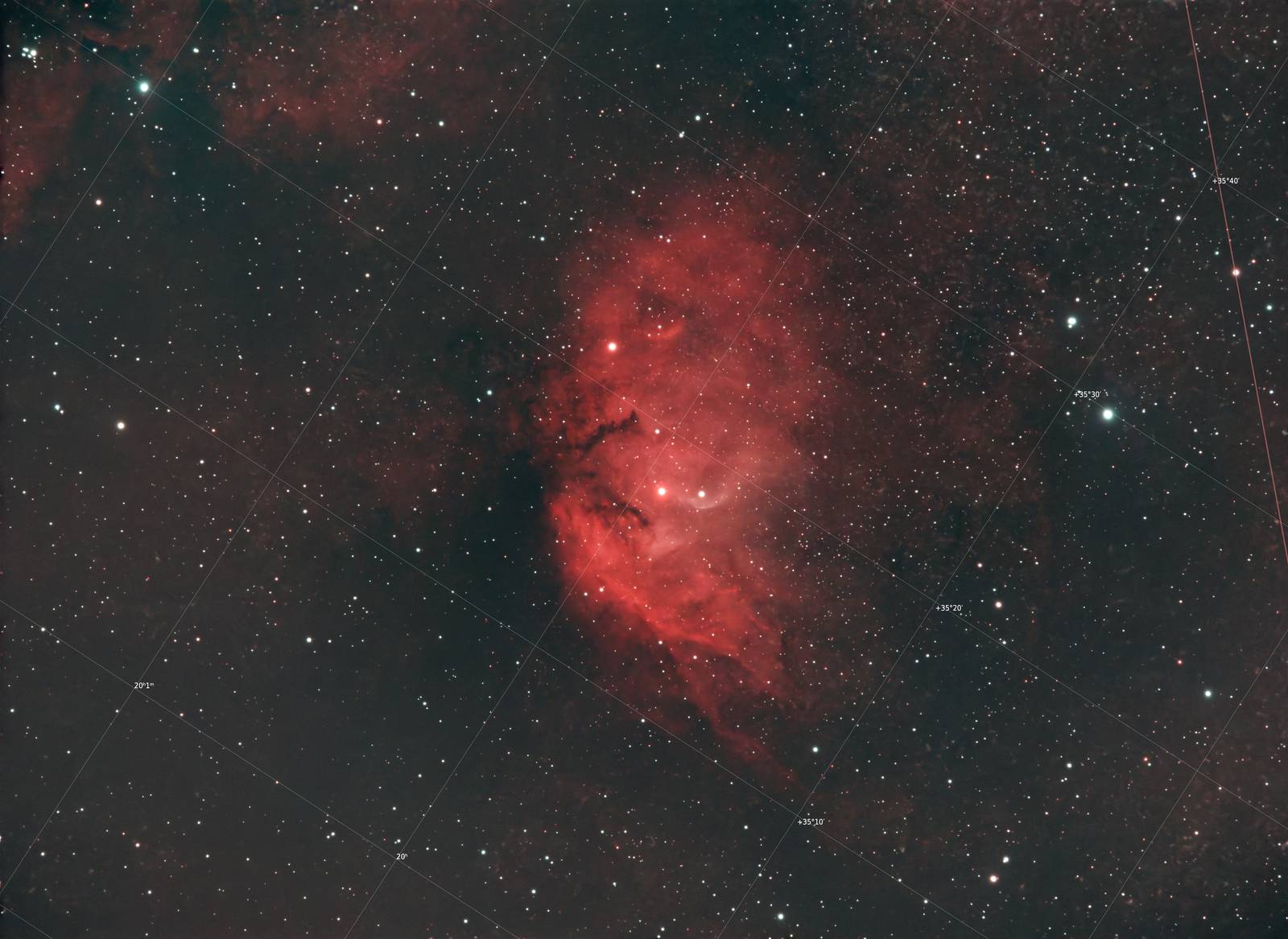
Image details
| Object type | HII region |
|---|---|
| Catalogue | SH 2-101 – LBN 168 – CED 173 |
| Constellation | Cygnus (Cyg) |
| Observed | 2026 Jul 30 – 23:27 UTC |
| Location | Portsmouth, UK |
| Moon | Waning Crescent – 14% illuminated – age 25.9 days |
| WordPress categories | Nebula |
Equipment
| Telescope | Skywatcher 127 Mak |
|---|---|
| Camera | ZWO ASI2600MC Pro |
| Mount | Juwei 17 |
| Filter | L-Enhance |
| Focal length | 1500mm |
| F-ratio | f/11 |
| Pixel scale | 0.52 arcsec/pixel |
Acquisition
| Exposure | 147 x 120s |
|---|---|
| Gain | 100 |
| Guiding RMS | Not recorded |
Observation notes
I I purchased a cheap Angeleyes F/6.3 SCT reducer/corrector to see what could be achieved with the Sky-Watcher 127mm. With the reducer fitted, the telescope’s effective focal length is around 1,060mm, giving an approximate focal ratio of f/8.3.
For a first attempt using what is essentially a telescope hack, the results were encouraging. There was quite a lot of vignetting, but as I would crop the image when capturing smaller objects anyway, this isn’t a major issue. Overall, I’m pleased with my first attempt at speeding up the 127mm for imaging.
I’ve had great fun experimenting and have achieved some reasonable results. It makes me wonder why manufacturers don’t produce more telescopes like this, as they’re clearly capable of DSO imaging.
Processing notes
Processed and stacked in PixInsight and Astro Pixel Processor.
Posted from CityAstroLog.