
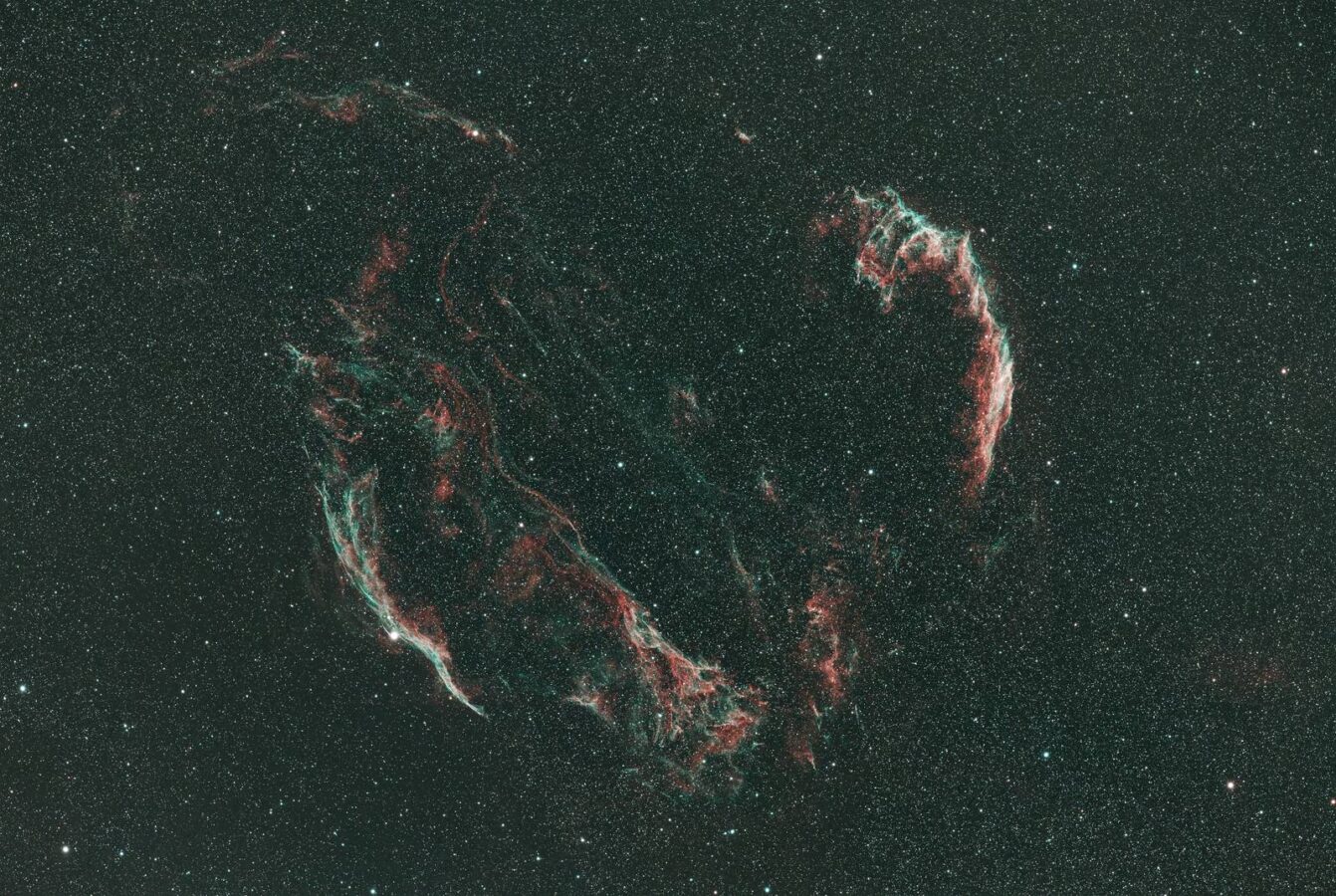
Veil Nebula
About this image
Situated approximately 2,400 light-years away in the constellation Cygnus (the Swan), the Veil Nebula is one of the most spectacular supernova remnants visible from Earth. Its delicate, wispy filaments of glowing gas are all that remain of a massive star that ended its life in a violent explosion thousands of years ago.
Despite its fragile appearance, the Veil Nebula is the aftermath of an extraordinarily powerful event. Around 10,000–20,000 years ago, a massive star, thought to have been around 20 times the mass of our Sun, exploded as a supernova. The resulting shock wave expanded into the surrounding interstellar medium, creating an enormous shell of gas that continues to expand today.
A Vast Structure in the Night Sky
The Veil Nebula forms part of the much larger Cygnus Loop, a supernova remnant spanning approximately 110 light-years across. From Earth, it covers an area of sky roughly six times the diameter of the full Moon.
The nebula is divided into several prominent regions:
Western Veil (NGC 6960): Also known as the Witch's Broom, this section appears to sweep past the bright foreground star 52 Cygni.
Eastern Veil (NGC 6992/6995): A complex network of bright, twisting filaments extending across the eastern portion of the remnant.
Pickering's Triangle: A fainter, intricate region of nebulosity located between the eastern and western sections.
The Science Behind the Colours
The beautiful red, blue and green structures commonly seen in astrophotographs are produced by different elements within the expanding gas.
Hydrogen emits predominantly red light, while doubly ionised oxygen (OIII) produces the striking blue-green filaments. These emissions occur as the supernova shock wave heats and excites the surrounding gas.
The fine, thread-like structures reveal the interaction between the expanding shock front and the interstellar medium. What appears to be a delicate cloud is actually a vast region of energetic, rapidly moving material.
Photographing the Veil Nebula
The Veil Nebula is a particularly rewarding target for narrowband astrophotography. Filters that isolate hydrogen-alpha and oxygen-III emissions help reveal its extraordinary structure, even under light-polluted skies.
Wide-field telescopes are ideal for capturing the entire Cygnus Loop, while longer focal lengths allow individual regions to be explored in greater detail.
One of the most fascinating aspects of imaging the Veil is that we are recording the continuing expansion of a stellar explosion. The intricate filaments are not static clouds but part of an evolving shock wave travelling through space.
A Glimpse into the Future of Stars
The Veil Nebula provides a remarkable insight into the life cycle of massive stars. Supernova explosions disperse elements into the interstellar medium, enriching the material from which future generations of stars and planets can form.
Image details
| Object type | Nebula |
|---|---|
| Catalogue | NGC 6974 |
| Constellation | Cygnus (Cyg) |
| Observed | 2025 Jun 21 – 23:35 UTC |
| Location | Portsmouth, UK |
| Moon | New Moon – 0% illuminated – age 29.3 days |
| WordPress categories | Nebula |
Equipment
| Telescope | William Optics RedCat 51 |
|---|---|
| Camera | ZWO ASI2600MC Pro |
| Mount | AM5 / Juwei 17 |
| Filter | Optolong L-eNhance |
| Focal length | 250mm |
| F-ratio | f/4.9 |
| Pixel scale | 3.1 arcsec/pixel |
Acquisition
| Exposure | Not recorded |
|---|---|
| Gain | Not recorded |
| Guiding RMS | Not recorded |
Posted from CityAstroLog.