
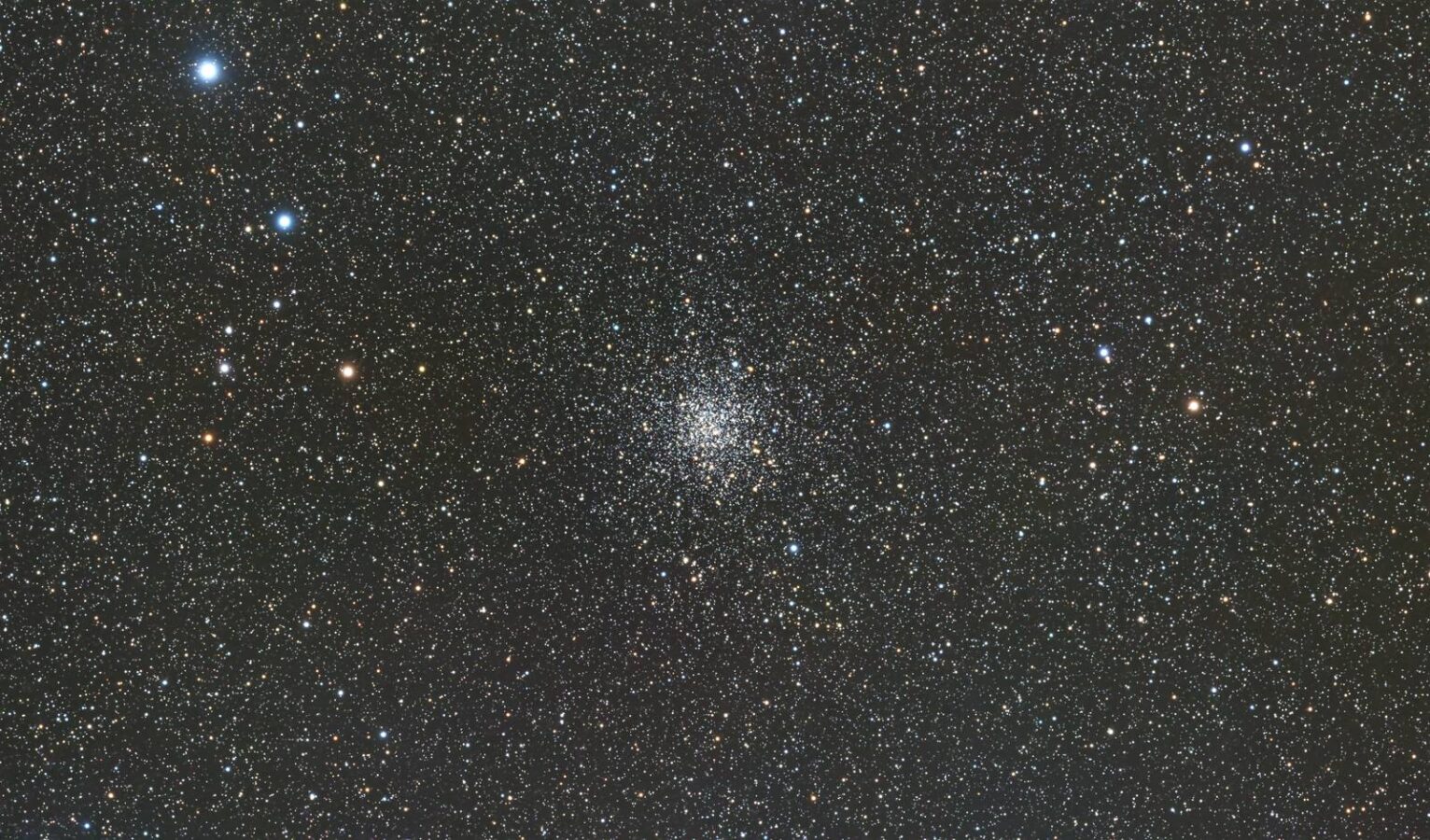
Angelfish Cluster
About this image
Located approximately 13,000 light-years away in the constellation Sagitta (the Arrow), Messier 71 (NGC 6838) is one of the Milky Way’s smallest and most unusual globular clusters.
Containing an estimated 20,000 stars within a region roughly 27 light-years across, M71 is a remarkable collection of ancient suns, gravitationally bound together for billions of years.
What makes M71 particularly interesting is that astronomers spent decades debating what it actually was. Unlike the densely packed globular clusters we typically associate with objects such as M13, M71 has a relatively loose stellar structure. For much of the twentieth century, it was classified as an open cluster before being recognised as a globular cluster in the 1970s.
Its stars are estimated to be 9–10 billion years old, making them roughly twice the age of our Sun. Interestingly, M71 also contains a relatively high abundance of heavier elements compared with many other globular clusters, another characteristic that contributed to its unusual classification history.
First discovered by Swiss astronomer Jean-Philippe de Chéseaux in the eighteenth century, M71 remains a fascinating astrophotography target. Its relatively loose structure allows individual stars to be resolved more readily than in some densely concentrated globular clusters, creating a beautiful field of ancient stars against the rich backdrop of the Milky Way.
Image details
| Object type | globular star cluster |
|---|---|
| Catalogue | M71, NGC 6838, M 71 – NGC 6838 – CR 409 – MEL 226 |
| Constellation | Sagitta (Sge) |
| Observed | 2026 Sep 21 – 23:05 UTC |
| Location | Portsmouth, UK |
| Moon | New Moon – 1% illuminated – age 28.6 days |
| WordPress categories | Star Clusters |
Equipment
| Telescope | Skywatcher 127 Mak |
|---|---|
| Camera | ZWO ASI2600MC Pro |
| Mount | Juwei 17 |
| Filter | None |
| Focal length | 1500mm |
| F-ratio | f/11 |
| Pixel scale | 0.52 arcsec/pixel |
Acquisition
| Exposure | 60 x 60s |
|---|---|
| Gain | 100 |
| Guiding RMS | Not recorded |
Posted from CityAstroLog.