
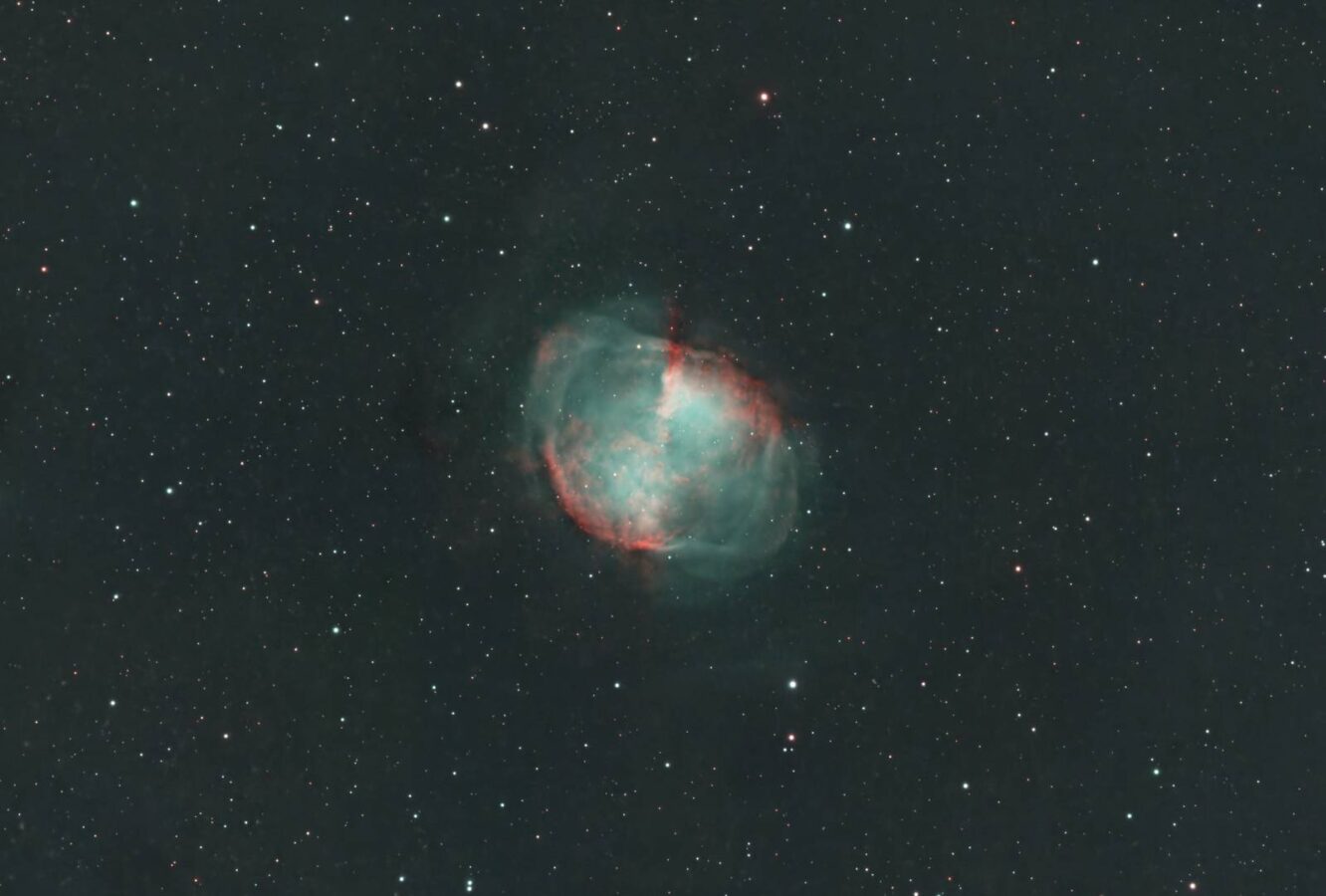
Dumbbell Nebula
About this image
M27, also known as the Dumbbell Nebula, is a planetary nebula in the constellation Vulpecula. Despite the name, a planetary nebula has nothing to do with planets. It is the glowing outer shell of gas thrown off by a dying Sun-like star near the end of its life.
At the centre of M27 is a hot white dwarf star, the exposed core of the original star. Its intense ultraviolet light causes the surrounding gas to glow. The blue-green regions are mainly oxygen, while the redder areas are from hydrogen and nitrogen.
M27 is one of the brightest planetary nebulae in the night sky and was the first object of this type to be discovered. It lies roughly 1,200 light years away and shows us a possible future stage in the life of stars like our own Sun.
Annotated image
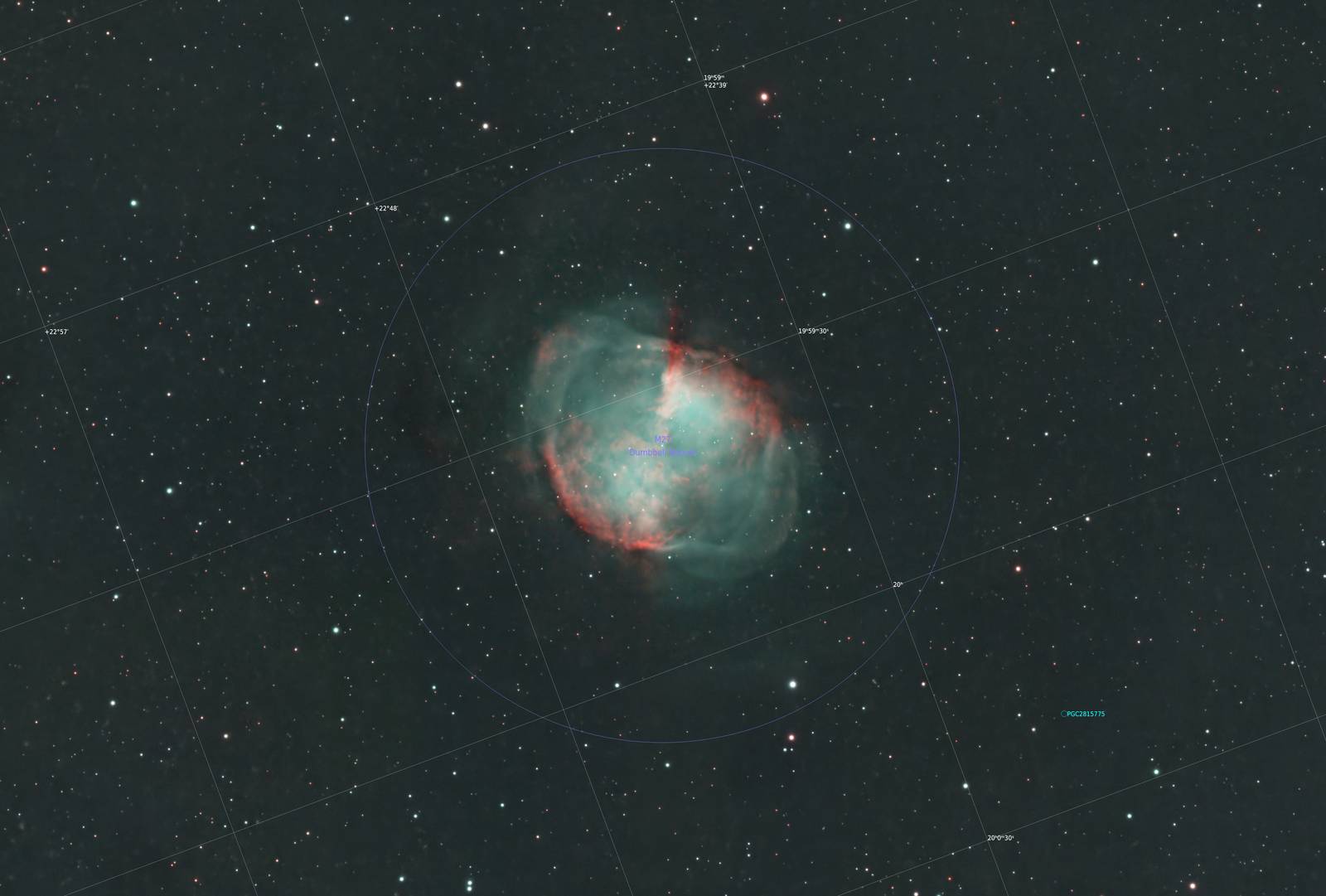
Image details
| Object type | planetary nebula |
|---|---|
| Catalogue | M27, NGC 6853, PK 060-03.1, PN G060.8-03.6, M 27 – NGC 6853 – PK 060-03.1 – PN G060.8-03.6 |
| Constellation | Vulpecula (Vul) |
| Observed | 2026 Jun 27 – 23:27 UTC |
| Location | Portsmouth, UK |
| Moon | Waxing Gibbous – 95% illuminated – age 12.7 days |
| WordPress categories | Nebula |
Equipment
| Telescope | Skywatcher 127 Mak |
|---|---|
| Camera | ZWO ASI2600MC Pro |
| Mount | Juwei 17 |
| Filter | L-Enhance |
| Focal length | 1500mm |
| F-ratio | f/11 |
| Pixel scale | 0.52 arcsec/pixel |
Acquisition
| Exposure | 27 x 120, 119 x 120s |
|---|---|
| Gain | 100 |
| Guiding RMS | 0.6 -1.0 |
Observation notes
Another experiment. Taken over two nights, 27 June & 8th July 2026. Just starting to see the wings.
Processing notes
I used Astro Pixel Processor to stack each night and then combine. Again, I used masks to bring out the core, and colour masks to concentrate on the different colours. Needs additional time to bring out the wings, but getting there. Not bad for a 20 year 127mm MAK at F11/12
Posted from CityAstroLog.