
Getting Started with Stellar Photometry Using the Seestar S50
A practical guide to recording variable stars, plotting light curves and understanding what the numbers mean.
My first experiment: V572 Camelopardalis (V572 Cam) | Seestar S50 | 27 October 2026
Why I tried photometry
I’ve spent years imaging galaxies, nebulae and planets, but photometry takes astronomy in a different direction. Instead of producing a photograph, I’m measuring how the brightness of a star changes over time. The exciting bit is that a small smart telescope can record a pulsation cycle in a single evening.
For my first experiment, I observed V572 Cam, a High-Amplitude Delta Scuti (HADS) star, using 10-second exposures with my Seestar S50. The American Association of Variable Star Observers (AAVSO) recommends HADS stars for first digital-photometry observations and lists V572 Cam among its northern beginner targets. [1]
1. What is stellar photometry?
Photometry measures light. Variable-star photometry measures how the light from a star changes over time. Some stars physically pulsate; others dim when one star passes in front of another, or vary because of rotation and starspots.
A sequence of brightness measurements produces a light curve, a graph that can reveal the period and shape of those changes.
Astronomical magnitudes work backwards: a smaller number means a brighter star. A change of one magnitude represents a brightness factor of approximately 2.512. The vertical axis on a light curve is therefore normally reversed so brighter points appear higher on the graph.
2. Why choose V572 Cam?
V572 Cam is a HADS variable. Its light output changes over a relatively short cycle as the star pulsates.
The AAVSO lists its approximate V-band magnitude range as 11.5–11.9 and its period as 124 minutes. This means a few hours of observing should reveal a repeating rise and fall in brightness.
This is much easier for a beginner than observing a variable star that needs weeks or months of measurements.
The distinctive rapid brightening and more gradual fading can be seen in a good HADS light curve.
For V572 Cam (TYC 4556-1113-1), use the following coordinates:
| Coordinate | Value |
|---|---|
| Right Ascension (RA) | 12h 03m 19.5s |
| Declination (Dec) | +80° 33′ 42.5″ |
| Constellation | Camelopardalis |
3. Setting up the Seestar S50
- Choose a stable position with an unobstructed view of the star. Avoid nearby lights and excessive wind.
- Connect to the Seestar through the app, check the focus and allow the telescope to acclimatise.
- Locate V572 Cam using the star map or its catalogue coordinates. Confirm that the correct star field has been selected.
- Open the Photometry feature. Menus and export options may vary with firmware and software updates.
- Use repeatable short exposures. I used 10 seconds, allowing a large number of measurements during the session.
- Collect at least one complete pulsation cycle. Three or more cycles will help produce a more reliable period estimate.
- Save the exported CSV and any available individual FITS files for further analysis.
4. My Seestar observations: the actual data
The following results were obtained from my observing session on 27 October 2026. These are preliminary measurements exported from the Seestar, rather than independently calibrated standard-band photometry.
My complete excel data can be found here: Excel Data
| Measurement | Result |
|---|---|
| Target | V572 Cam |
| Recorded star identifier | TYC 4556-1113-1 |
| Telescope | Seestar S50 |
| Exposure time | 10 seconds |
| Recorded measurements | 1,204 |
| First exposure (UTC) | 18:02:32 |
| Last exposure (UTC) | 21:49:06 |
| Session duration | 3 hours 47 minutes |
| Mean reported magnitude | 11.355 |
| Mean reported magnitude error | 0.100 mag |
| Mean SNR | 11.9 |
| Preliminary period estimate | 2.06 hours |
| Preliminary fitted amplitude | Approximately 0.45 magnitude |
My V572 Cam light curve
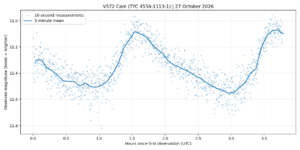
Figure 1. My V572 Cam light curve recorded with the Seestar S50. Individual 10-second measurements show considerable scatter, while five-minute averages reveal the repeating pulsation pattern. Lower magnitudes represent greater brightness.
The data show a repeating brightness pattern broadly consistent with V572 Cam’s known pulsation.
My preliminary period estimate of 2.06 hours is close to the approximately 124-minute period published by the AAVSO. However, my session covered only around 1.8 pulsation cycles, so this shouldn’t be regarded as a precise determination of the period. [1]
Nevertheless, what I found particularly interesting was seeing the star’s brightness change over a relatively short time. It’s quite remarkable that a small smart telescope can record this behaviour from the back garden.
Completed Excelsheet: https://cityastro.uk/wp-content/uploads/2026/10/V572_Cam_Light_Curve_With_Period_Calculation.xlsx
5. What I’ll try next
My next aim is a longer session on V572 Cam, ideally six to eight hours, allowing me to record several complete pulsation cycles.
I’d also like to analyse the individual FITS exposures independently, compare the results with AAVSO reference data and become more familiar with VStar.
What appeals to me most about photometry is that it adds another dimension to amateur astronomy.
Rather than simply recording how an astronomical object looks, we’re measuring what it’s actually doing.
And with something as accessible as the Seestar S50, it’s a fascinating area of astronomy that’s now within reach of many more people.
Clear skies!
References and further reading
[1] AAVSO – Your First Observing Target.
https://aavso.org/your-first-observing-target/
[2] AAVSO – Stellar Photometry.
https://aavso.org/stellar-photometry/
[3] AAVSO – Guide to CCD/CMOS Photometry.
https://www.aavso.org/sites/default/files/publications_files/ccd_photometry_guide/CCDPhotometryGuide.pdf
[4] AAVSO – VStar Variable Star Analysis Software.
https://archive.aavso.org/index.php/vstar-overview
[5] AAVSO – VStar User Manual.
https://www.aavso.org/sites/default/files/vstar/doc/VStarUserManual.pdf
[6] AAVSO – Photometry Manuals.
https://aavso.org/manuals/
Observational data and light-curve illustration: my own Seestar S50 session, 27 October 2026.